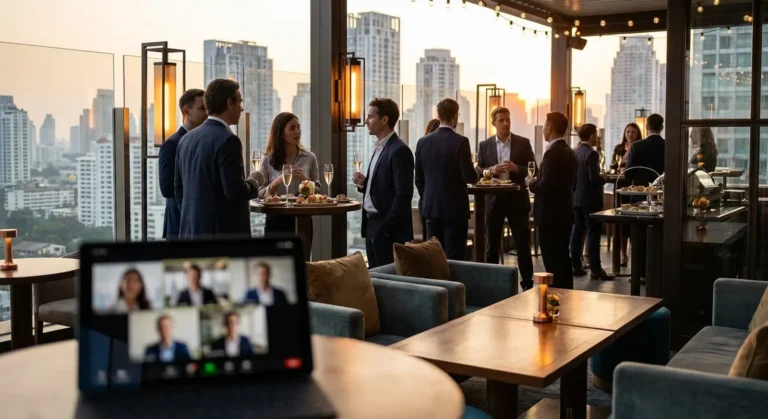
Best Corporate Hospitality United States: A Strategic Pillar Guide
The strategic application of corporate hospitality is a pillar of modern business relationship management. Digital communication has commoditized professional interaction. Now, curating high-impact physical environments for engagement is a critical differentiator. This practice transcends simple entertainment. It is an exercise in resource allocation, social engineering, and brand reinforcement. It requires a level of precision that mirrors complex supply chains or financial operations.
For the American enterprise, the landscape of engagement has shifted toward “experiential continuity.” Providing a high-end experience is no longer sufficient. The modern imperative is to integrate every touchpoint from the initial invitation to the post-event follow-up into the organization’s broader strategic goals. Economic volatility and shifting labor dynamics continue to influence how firms invest in stakeholder relations. Consequently, mastery of this discipline has become a prerequisite for maintaining long-term institutional authority.
Understanding “best corporate hospitality united states.”
Defining the best corporate hospitality in the United States market requires looking beyond the superficial veneer of luxury. It is frequently misconstrued as “expensive entertainment.” This oversimplification obscures the true objective: converting transactional business into relational capital. True corporate hospitality orchestrates a setting such as high-stakes events, exclusive access, or refined dining where business objectives can be pursued in a state of lowered friction and heightened engagement.
Approaching this as a mere “perk” risks losing strategic focus. The most effective programs treat hospitality as a tactical asset. ROI is measured not by immediate deal closings, but by the sustained growth of trust and brand equity. Misunderstandings often stem from an obsession with the event itself rather than the guest’s journey. When the experience is prioritized over the objective, the program becomes an aesthetic exercise instead of a business tool.
Historical and Systemic Evolution of Business Engagement
The American trajectory of corporate hospitality has evolved significantly. It has shifted from mid-20th-century informal handshake dinners and golf outings to the highly codified, data-driven systems seen in 2026. Historically, hospitality was an intuitive, decentralized process managed by individual executives. As organizational structures expanded and federal regulations regarding expenses and transparency tightened, the practice underwent institutionalization.
Today, the sector is defined by technological integration and the pursuit of “authentic exclusivity.” The rise of agentic AI and predictive analytics allows firms to anticipate guest needs with precision. The industry is moving toward a model of hyper-personalization. The traditional “standard package” is increasingly obsolete. It is being replaced by modular, bespoke programs that align with the values and cultures of both host and recipient.
Conceptual Frameworks for Strategic Hospitality
-
The Intent-to-Impact Model: Before approving expenditure, define your relational goal. Is the hospitality intended to deepen an existing partnership, facilitate an acquisition, or demonstrate corporate appreciation? Your intent determines the intensity and the environment.
-
The Friction-Coefficient Framework: Evaluate the “friction” of your current engagement. If standard business interactions are high-stress or bureaucratic, your hospitality should function as an “anti-friction” zone. It should be a space where logistics disappear.
-
The Lifecycle Continuity Model: Treat hospitality as a recurring loop rather than a discrete event. Knowledge gained during an event, including preferences, concerns, and social dynamics, should be cycled back into the CRM. This informs future interactions and maximizes long-term value.
Key Categories and Operational Variations
| Category | Typical Utility | Strategic Focus | Primary Limitation |
| High-Access Sporting | Networking in exclusive suites | Status & Rapport | High noise/Low focus |
| Curated Cultural Events | Small-group intimacy | Trust-building | Scalability issues |
| Executive Retreats | Strategic alignment/Deep work | Long-term strategy | High resource investment |
| Brand-Integrated Hospitality | Product immersion/Launch | Brand perception | Potential for distraction |
Effective decision logic dictates that the venue must never overpower the business objective. If the event is so loud or distracting that substantive dialogue is impossible, the hospitality has failed, regardless of how premium the setting.
Real-World Scenario Modeling
Scenario 1: The High-Stakes Client Retention
A long-term, high-value client is showing signs of disengagement.
-
Decision Point: Avoid large, impersonal events. Prioritize a curated, small-group experience where the client’s personal interests are central to the agenda.
-
Failure Mode: Assuming that “exclusive access” alone will mend a strained relationship.
Scenario 2: The New Market Entry
An organization is looking to establish credibility in a new region.
-
Decision Point: Leverage local partnerships. Host an event that connects the firm with key local influencers or stakeholders in an environment that reflects both the host’s identity and the local culture.
-
Second-Order Effect: Failure to integrate into the local ecosystem can leave an event feeling artificial or detached.
Planning, Cost, and Resource Dynamics
The variability in costs is driven by “logistical intensity.” A gala dinner has a predictable cost profile, whereas a remote, multi-day retreat involves cascading variables like security, private aviation, and specialized staffing.
| Investment Tier | Typical Focus | Resource Intensity |
| Foundational | Standard networking events | Moderate |
| Advanced | Bespoke client-specific experiences | High |
| Strategic/Institutional | Full-cycle relationship management | Very High |
Operational Tools and Support Systems
-
Unified Data Integration: Ensure your hospitality metrics are tracked within your primary CRM, not in isolated spreadsheets.
-
Telemetry-Driven Logistics: Use real-time flight and transit monitoring to manage the “arrival experience,” ensuring that delays never impact the guest’s perception of your efficiency.
-
Encrypted Privacy Protocols: As the stakes rise, the protection of client information during events becomes as vital as the quality of the service itself.
-
Vendor Vetting Portals: Standardize your supply chain by using a vetted directory of high-end vendors who understand the specific needs of corporate environments.
The Risk Landscape: Failure Modes and Compounding Risks
The most dangerous risk is the “performative failure” where a firm attempts to host a high-prestige event without the operational infrastructure to support it. A failed arrival, a poorly managed dietary restriction, or an unprofessional vendor can cause more reputational damage than not hosting the event at all. Compounding this is the “intermediary risk,” where you rely on third-party agencies that lack deep alignment with your internal brand values.
Governance, Maintenance, and Long-Term Adaptation
Treat your hospitality program as a living organism. Implement a quarterly review cycle to assess whether your events remain aligned with your evolving business strategy. Use a “layered checklist” to monitor quality across different regions, ensuring that a firm’s commitment to excellence remains consistent whether the event is in New York, London, or Singapore.
Measurement, Tracking, and Evaluation
-
Leading Indicators: The rate of guest engagement, the clarity of invitation acceptance, and the quality of pre-event communication.
-
Lagging Indicators: The longitudinal impact on contract renewals, net promoter scores (NPS) from clients, and qualitative feedback gathered in post-event debriefs.
-
Documentation: Maintain a “hospitality ledger” for every major client, documenting their preferences, event history, and the specific strategic outcome of each interaction.
Common Misconceptions and Oversimplifications
-
Myth: “Hospitality is a cost center.”
-
Correction: It is a strategic investment that, when managed correctly, yields clear returns in retention and acquisition.
-
Myth: “Bigger is always better.”
-
Correction: Intimacy is often the most powerful tool for meaningful connection.
-
Myth: “You can outsource the entire program to an agency.”
-
Correction: You can outsource the logistics, but you can never outsource the strategy or the relationship.
Ethical and Contextual Considerations
The landscape of corporate hospitality is governed by strict regulations, particularly regarding the acceptance of gifts or travel by government officials or certain highly regulated private sector employees. Ethical governance requires a robust, proactive compliance framework. Beyond legality, there is the social responsibility of the “impact footprint”—ensuring that your events are sustainable and respectful of the communities in which they are held.
Conclusion
The best corporate hospitality United States firms can facilitate are those that effectively synthesize business strategy with the nuances of human experience. By moving past the temptation of simple extravagance and focusing on the rigorous, data-driven, and highly personal orchestration of events, an organization creates a resilient foundation for long-term growth. True success in this domain is rarely about the event itself, but about the enduring trust and professional alignment fostered long after the lights have dimmed. As the market continues to evolve toward higher levels of technological integration and personalization, those who maintain the human touch anchored by institutional discipline will continue to lead.